The best architectural wood details are usually the ones that look effortless. A clean wall of wood cladding. A ceiling plane with uninterrupted grain. A deck surface without rows of plugs or exposed screw heads. On the finished project, the design feels simple. Behind that simplicity, however, there is a lot of discipline: board selection, moisture management, milling accuracy, fastener choice, installation sequence, and long-term serviceability.
That is why more architects and builders are paying close attention to fastening systems early in the specification process. Wood is not just a finish material. It is a moving, weathering, natural product that needs the right attachment strategy. For years, face-fastening was treated as the default approach because it is familiar and direct. The installer places the board, drives the fastener through the face, and moves on. It works, but it also leaves the fastener pattern visible, creates more penetrations through the board, and can make replacement more complicated when one board is damaged or needs access behind it.
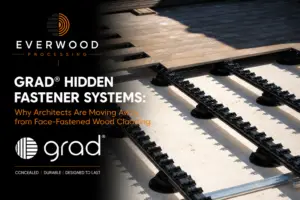
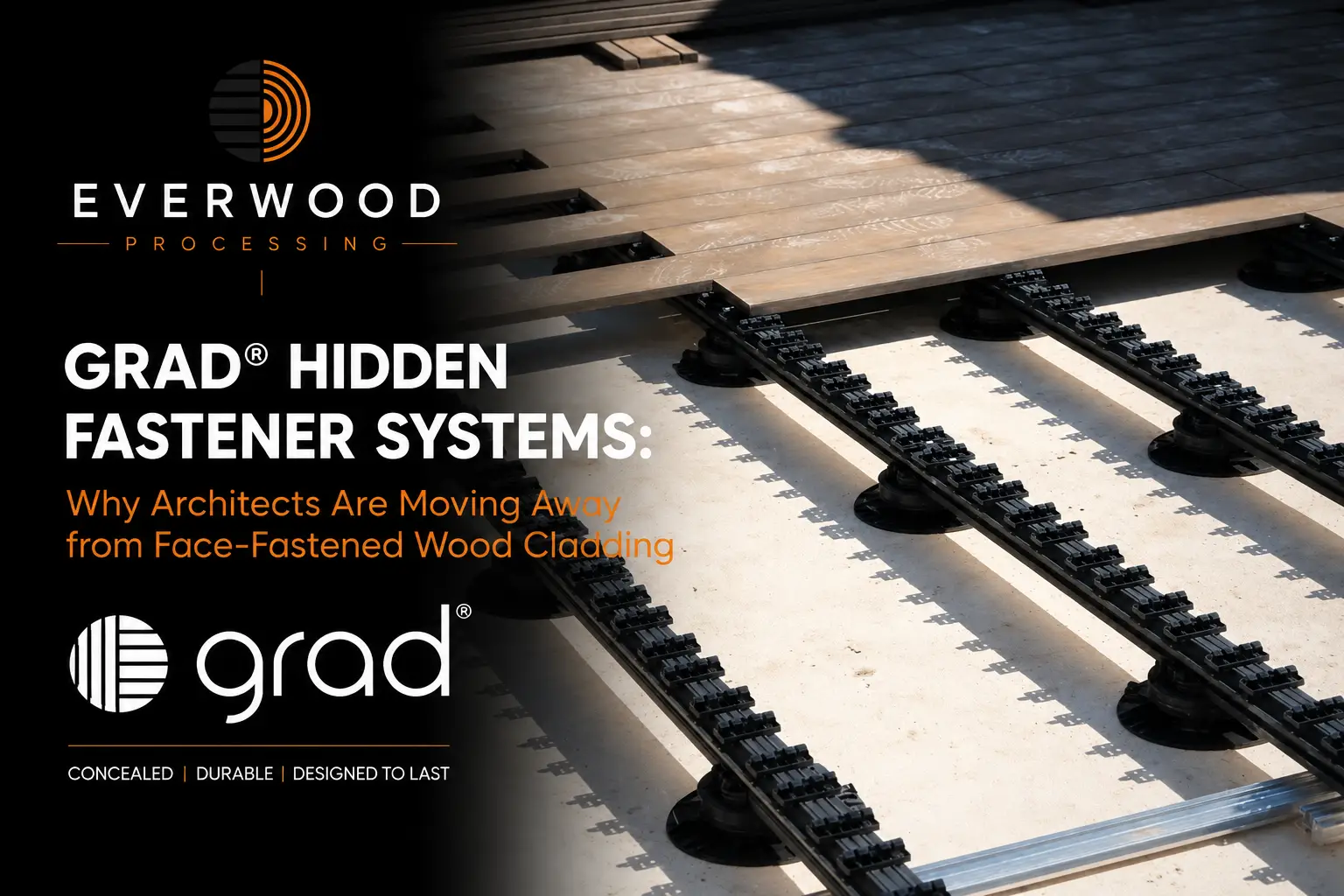
A GRAD hidden fastener system changes that relationship. Instead of driving individual screws through the exposed surface of every board, compatible boards are milled with a groove that locks onto clips mounted to rails. GRAD Concept describes the system as a clip-on installation method for decking, cladding, ceilings, and lumber designs, focused on saving time on site while maintaining a clean finished surface.
For architects, that means the fastening method becomes part of the design language. For builders, it means labor efficiency and repeatable spacing. For owners, it means a finished wood assembly that looks intentional and can be serviced with less disruption. Everwood Processing supports that process by custom milling compatible grooves into selected wood species, helping design and construction teams move from a beautiful concept to a practical installation-ready material package.
The Problem with Treating Fasteners as an Afterthought
Fasteners are often invisible in early renderings. A cladding elevation may show a continuous field of vertical or horizontal boards, but the fastening detail is left to the shop drawing stage. That creates problems. By the time fasteners are discussed, the species may already be selected, the profile may be set, and the installation budget may be fixed. If the board profile was not designed for a hidden system, the project may be forced back into exposed screws, plugs, or improvised clips.
With face-fastened cladding, the fastener layout becomes part of the visual field whether the architect wants it or not. Screw heads can telegraph across an elevation. Plugs can age at a different rate than the surrounding board. Slight misalignment becomes obvious on large modern facades. On dark-stained or charred material, the fasteners may still catch light differently. On lighter woods, the fastener pattern may become a permanent grid over the design.
The issue is not only appearance. Every penetration through the face of a board is a potential point of stress, staining, water movement, or long-term maintenance. With exterior wood, details matter. Moisture must be managed. Boards must be allowed to move. Fasteners must hold securely without fighting the natural behavior of the material. A better fastening strategy reduces unnecessary compromises before they become jobsite problems.
What Makes the GRAD System Different
The GRAD approach uses rails with pre-mounted clips. Boards are milled with a compatible groove, then snapped into place. Arbor Wood Co. describes the GRAD hidden clip-on system as a fast and secure method for siding and decking, noting that its rail design creates an air gap, while pre-mounted clips create uniform spacing between boards. GRAD hidden clip-on systemThis is a meaningful shift from fastening each board individually through the face.
That rail-and-clip logic creates several project-level advantages. The rails organize the installation plane. The clips control spacing. The groove allows the board to engage mechanically without exposed fasteners through the face. Once the installer understands the sequence, the work becomes more repeatable. That matters on large walls, long soffits, deck surfaces, and commercial projects where consistency is not optional.
The official GRAD USA brochure explains that compatible decking and cladding boards are slotted with a special groove to accommodate patented GRAD clips, and that boards can be snapped onto the clips after the aluminum rails have been placed according to plan. That language highlights the key coordination point: the wood must be prepared correctly before it gets to the site.
This is where Everwood Processing fits into the workflow. EWP is not simply talking about GRAD as a product. EWP custom mills the groove profile into selected boards so that the material arrives ready for the system. That processing step can support decking, cladding, ceilings, soffits, and wall applications, depending on the species, profile, and final assembly design.
Why Architects Prefer the Cleaner Elevation
Modern architecture often depends on restraint. Clean lines. Narrow shadow gaps. Consistent reveals. Natural materials used with precision. A hidden fastener system supports that language because the eye reads the wood, not the screw pattern. The surface can feel more like a crafted architectural plane than a collection of boards attached one at a time.
That is especially important for premium wood species and specialty finishes. If a project is using Kebony, Accoya, thermally modified wood, charred cladding, wire-brushed material, or a custom oil finish, the finish surface is part of the value. Exposed fasteners can interrupt that investment. Hidden fastening protects the visual integrity of the material.
There is also a specification advantage. A hidden fastener wood cladding system gives the architect a more complete detail to communicate. Instead of calling out wood species and leaving attachment open-ended, the design team can coordinate the material, groove, rail, clip, orientation, and layout intent. The result is a cleaner submittal path and fewer assumptions between design, supply, fabrication, and installation.
Speed and Consistency Matter on Site
Labor is one of the most expensive variables in construction. Any system that reduces repetitive layout decisions can have real value. Face-fastening requires layout, spacing, alignment, pre-drilling in some cases, fastening, and often touch-up or plug work. On a small accent wall, that may be manageable. On a commercial facade, a large deck, or a ceiling installation, those small steps add up quickly.
GRAD’s pre-mounted clip approach is designed to make installation more systematic. The rails go in first. The boards then engage with the clips. Because the clips are already positioned on the rail, spacing is more controlled than a fully manual clip-by-clip process. The result is not just speed, but repeatability.
That repeatability is important because many wood installation defects are not dramatic failures. They are small inconsistencies that accumulate visually: a gap that opens too wide, a fastener line that drifts, a board that sits slightly proud, a starter course that is not perfectly organized. A system-based installation reduces the number of decisions an installer has to make while balancing speed with accuracy.
For builders, that can simplify training and sequencing. For architects, it protects the design intent. For owners, it reduces the chance that an expensive natural wood installation will look uneven because each board was handled differently.
Board Removability Is a Practical Advantage
One of the most underrated benefits of a clip-on hidden fastening system is serviceability. Buildings need access. Decks need repairs. Cladding may need an isolated board replaced after damage. Mechanical or drainage conditions behind a surface may need inspection. A face-fastened assembly can be repaired, but the process often involves visible patching, plug removal, fastener extraction, or replacing more material than originally planned.
GRAD’s system is widely promoted for board-by-board removability. The UK GRAD system overview describes the system as 100% removable board by board with dismantling keys, while also emphasizing invisible fastening and pre-mounted clips. GRAD system overview That serviceability can be valuable in both commercial and residential construction.
Think about a rooftop deck over occupied space. Access to drainage, waterproofing, or utilities may eventually matter. Think about a wall cladding system where one board is damaged during later construction. Think about a high-end residence where an owner wants maintenance without a visible repair scar. A removable system gives the project team another option before demolition becomes the default.
Removability should never be treated as a substitute for proper design, flashing, ventilation, or installation. But when paired with good detailing, it creates a more intelligent assembly.
The Groove Is the Critical Detail
The GRAD system depends on accurate board preparation. The groove is not decorative. It is the mechanical interface between the board and the clip. If the groove is inconsistent, too shallow, too loose, or poorly aligned, the installation suffers. That is why custom milling is not a minor step. It is the step that determines whether the selected material can perform properly within the system.
Everwood Processing provides GRAD milling as a dedicated capability, not as an afterthought. That matters because different wood species behave differently. Density, moisture content, board thickness, profile geometry, and finish sequence can all affect how material should be handled. A processor that understands architectural wood applications can help identify the right path before the material goes to the jobsite.
EWP can also help builders avoid the common trap of trying to adapt jobsite material to a precision system too late. Milling should happen under controlled conditions, with repeatable setup and consistent quality checks. The goal is simple: boards that fit the system cleanly and support the design intent without field improvisation.
Better for Premium Wood Packages
The more valuable the wood package, the more important the attachment strategy becomes. If a project uses a commodity board in a secondary application, exposed fasteners may be acceptable. But when the design calls for premium architectural material, the fastener system should match the level of finish.
Hidden fastening is especially relevant for applications such as:
- Vertical or horizontal exterior cladding on modern homes and commercial buildings
- Wood ceilings, soffits, and canopy applications where screw lines would be distracting
- Decks and terraces where barefoot comfort and a clean surface matter
- Feature walls, rainscreen assemblies, and specialty wood finishes
- Projects using custom-milled, charred, wire-brushed, or prefinished material
The real advantage is not only that the fasteners are hidden. It is that the entire package becomes more coordinated. Species, profile, finish, milling, and attachment all work together instead of being solved separately by different parties.
What Builders Should Confirm Before Choosing GRAD
A GRAD hidden fastener system can be a strong choice, but it still requires disciplined project coordination. Builders and architects should confirm the board profile, species, board dimensions, rail layout, substrate condition, ventilation strategy, finish sequence, and fastening requirements before ordering material.
Key questions include:
- Will the boards be used for cladding, decking, ceilings, soffits, or interior walls?
- What species and board dimensions are being specified?
- Does the board thickness support the required groove profile?
- Will the material be finished before or after milling?
- What rail style and clip layout does the installation require?
- Are there corners, openings, transitions, or removable access areas that need special planning?
These are exactly the kinds of questions that should be addressed before the project hits the field. Early coordination protects budget, schedule, appearance, and installation quality.
Why EWP Is Built for This Type of Work
Everwood Processing exists for projects where standard supply is not enough. A builder may be able to buy boards. A distributor may be able to ship material. But advanced wood processing requires more than order fulfillment. It requires controlled milling, finish awareness, species knowledge, and the ability to support custom architectural requirements.
For GRAD projects, EWP can help turn selected boards into system-ready material. That can include custom groove milling, coordination around application type, and support for wood packages that may also include Shou Sugi Ban, wire brushing, oiling, beams, cladding, decking, or ceiling elements. The value is not only in the machine work. The value is in reducing friction between design intent and field execution.
Architects want clean details. Builders want reliable installation. Owners want durability, beauty, and reasonable maintenance. A GRAD hidden fastener system, properly milled and planned, supports all three.
Takeaway
The move away from face-fastened wood is not just a design trend. It reflects a broader shift toward more integrated building systems. Premium wood deserves a fastening strategy that respects the material, protects the visual surface, simplifies installation, and supports long-term serviceability.
For architects and builders working with exterior cladding, decking, ceilings, soffits, or specialty wood applications, the fastening detail should be part of the conversation from the beginning. GRAD gives the project team a proven hidden-fastener path. Everwood Processing helps prepare the wood so that path can be executed with precision.
FAQs
What is a GRAD hidden fastener system?
A GRAD hidden fastener system uses rails with pre-mounted clips and boards milled with a compatible groove. The boards snap onto the clips, creating a clean surface without visible screws through the face of the wood.
Can GRAD be used for both decking and cladding?
Yes. GRAD systems are used for decking, cladding, ceilings, and related architectural wood applications, provided the board profile, groove, rail layout, and project conditions are properly coordinated.
Why is custom milling important for GRAD installations?
The groove is the mechanical connection between the board and the clip. Accurate milling helps ensure the board engages properly, maintains alignment, and supports a clean installation.
Is hidden fastening better than face-fastening?
It depends on the project, but hidden fastening is often preferred for premium architectural applications because it protects the finished surface, reduces visible fastener patterns, and can improve serviceability.
Can individual boards be replaced with a GRAD system?
GRAD systems are commonly promoted for board-by-board removability, depending on the exact system, installation, and access conditions. This can make repairs and access easier than many traditional face-fastened assemblies.
Who should consider GRAD milling from EWP?
Architects, builders, designers, and specialty contractors should consider EWP when they need wood prepared for GRAD-compatible hidden-fastener installations in cladding, decking, ceilings, soffits, or custom architectural features.