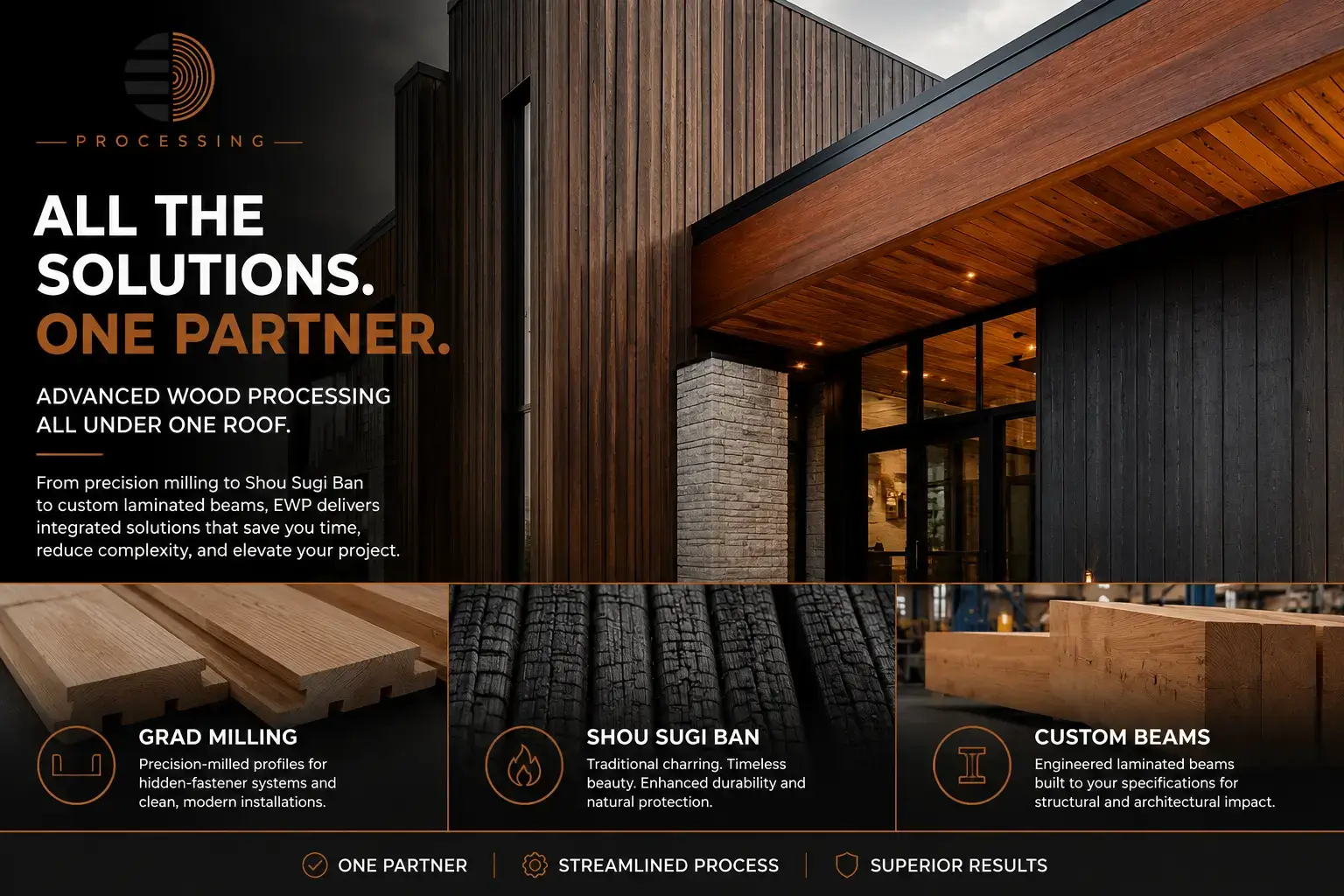
GRAD milling, Shou Sugi Ban, custom laminated beams, and finishing support from one coordinated Midwest production partner.
Architectural wood projects often look simple once installed, but the production path can be complicated. A single project may require species selection, hidden-fastener groove milling, Shou Sugi Ban charring, wire brushing, factory finishing, custom laminated beams, careful packaging, and coordinated delivery. When those steps are split between several vendors, the builder becomes the project manager for every handoff.
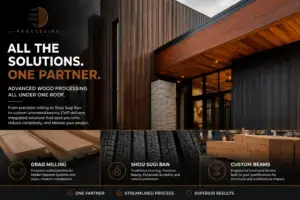
Everwood Processing, or EWP, was created to solve that problem. EWP is not just a GRAD milling provider, not just a Shou Sugi Ban finisher, and not just a custom beam shop. EWP combines multiple advanced wood processing services under one roof, giving architects, builders, and manufacturers a more coordinated path from raw material to installation-ready wood products.
The Problem With Using Separate Wood Processing Vendors
Many competitors specialize in one service. A milling shop may produce one groove profile. A charred wood supplier may focus on one surface treatment. A beam fabricator may only manufacture large members. Each specialty can be valuable, but problems appear when a project needs several of those scopes to work together.
For example, a premium cladding or decking package may need accurate board dimensions, hidden-fastener compatibility, surface finishing, and consistent visual character. If one vendor mills the boards, another chars them, another applies finish, and another handles beams, the risk of miscommunication increases. Lead times can stack, freight costs can rise, and accountability can become unclear. EWP reduces that friction by reviewing the application, material, profile, finish, and delivery requirements as one manufacturing workflow.
GRAD Milling for Clean Hidden-Fastener Installation
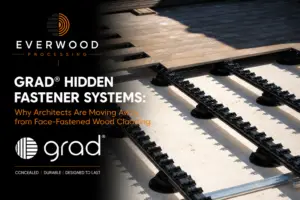
The GRAD system supports decking, cladding, ceilings, and other wood applications where a clean hidden-fastener appearance is important. Official GRAD Concept USA materials emphasize hidden fastening, efficient installation, and versatile wood applications. For that system to perform properly, boards must be milled with accurate and repeatable groove profiles.
EWP provides precision GRAD milling that prepares wood boards for the GRAD hidden-fastener system. This allows builders to install material without visible face screws while maintaining consistent spacing and a premium architectural appearance. Because EWP also supports finishing and other processing services, the groove-milling step can be coordinated with the full production sequence instead of treated as an isolated operation.
Shou Sugi Ban With Better Production Coordination
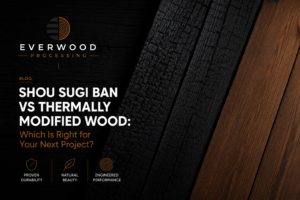
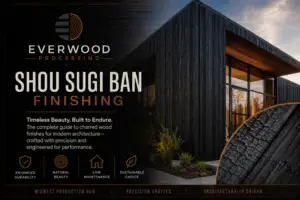
Shou Sugi Ban, also known as yakisugi, is a wood charring process used to create a bold architectural surface with deep texture and visual character. Technical research from the USDA Forest Service on charred wood siding is a useful reminder that performance claims should be made carefully, especially around durability and fire behavior.
For builders and designers, the main advantage of EWP’s Shou Sugi Ban capability is integration. Charring affects appearance, handling, finishing, and sequencing. The team can help determine whether a board should be charred before or after milling, whether it should be brushed, whether oil or another finish is appropriate, and how the material should be packaged to protect the surface. That type of coordination is difficult when charring is handled as a separate outsourced step.
Custom Laminated Beams as Part of the Same Wood Package
Custom laminated beams expand EWP’s value beyond boards and profiles. The American Wood Council describes glued laminated timber as layers of sawn lumber glued together to form large timbers that combine the beauty of wood with increased engineered strength.
EWP can support custom laminated beams for structural and architectural applications, including exposed timber elements, decorative features, and project-specific design requirements. The advantage is not only the beam itself. The advantage is that beams can be coordinated with cladding, decking, soffits, ceilings, walls, and finish direction. For high-end residential, commercial, and hospitality projects, that visual continuity matters.
Factory Finishing, Wire Brushing, and Installation-Ready Material
Wood construction depends on proper detailing, moisture management, and execution. Educational resources from WoodWorks are a strong authority for wood design and construction guidance. In practical terms, the more work that can be controlled before the material reaches the jobsite, the smoother the installation can become.
EWP’s wire brushing and finishing services help turn raw boards into installation-ready architectural material. Wire brushing can enhance the grain and create a more tactile surface. Factory-applied finishes can improve consistency and reduce field labor. When these services are combined with GRAD milling, Shou Sugi Ban, and custom beams, finishing becomes part of the manufacturing plan rather than an afterthought.
Why EWP’s Under-One-Roof Model Beats Narrow-Scope Competitors
EWP’s competitive advantage is coordination. A single-service competitor may perform one task well, but EWP can help plan the full package: material sourcing, supplied material options, GRAD milling, charring, brushing, finishing, beam production, samples, quoting support, and shipping from a Midwest production hub.
That creates four major benefits. First, it improves schedule control because production steps can be sequenced together. Second, it improves design consistency because profiles, colors, textures, and applications are reviewed together. Third, it reduces handling and freight complexity by limiting unnecessary movement between vendors. Fourth, it provides clearer accountability because one partner is responsible for more of the finished wood package.
For architects, this means more freedom to specify distinctive wood applications with a realistic production path. For builders, it means fewer loose ends and fewer vendor handoffs. For manufacturers and suppliers, it creates access to specialized processing without investing in every machine or finish process internally.
Applications EWP Can Support
EWP’s services apply across cladding and siding, decking and patios, ceilings and walls, soffits, beams, and specialty architectural wood projects. These applications often overlap. A modern home may include GRAD-milled decking, vertical charred cladding, warm natural soffits, and exposed laminated beams. A commercial project may need a feature wall, exterior facade, and ceiling system that all share a consistent material language.
By bringing these capabilities together, EWP helps bridge the gap between design intent and installation-ready material. The result is a cleaner process, a stronger finished appearance, and a more efficient path from raw wood to completed architectural application.
Frequently Asked Questions
What does advanced wood processing mean?
It refers to specialized manufacturing services such as precision milling, hidden-fastener groove preparation, charring, brushing, laminating, and factory finishing.
Can EWP process customer-supplied material?
Yes. EWP can work with supplied, sourced, or customer-supplied material depending on species, dimensions, and project requirements.
Why combine GRAD milling and finishing with one partner?
Combining these services helps control sequencing, protect milled profiles, improve consistency, and reduce coordination problems between vendors.
Is Shou Sugi Ban only for cladding?
No. It can also be used for feature walls, soffits, accents, and specialty architectural details depending on the project.