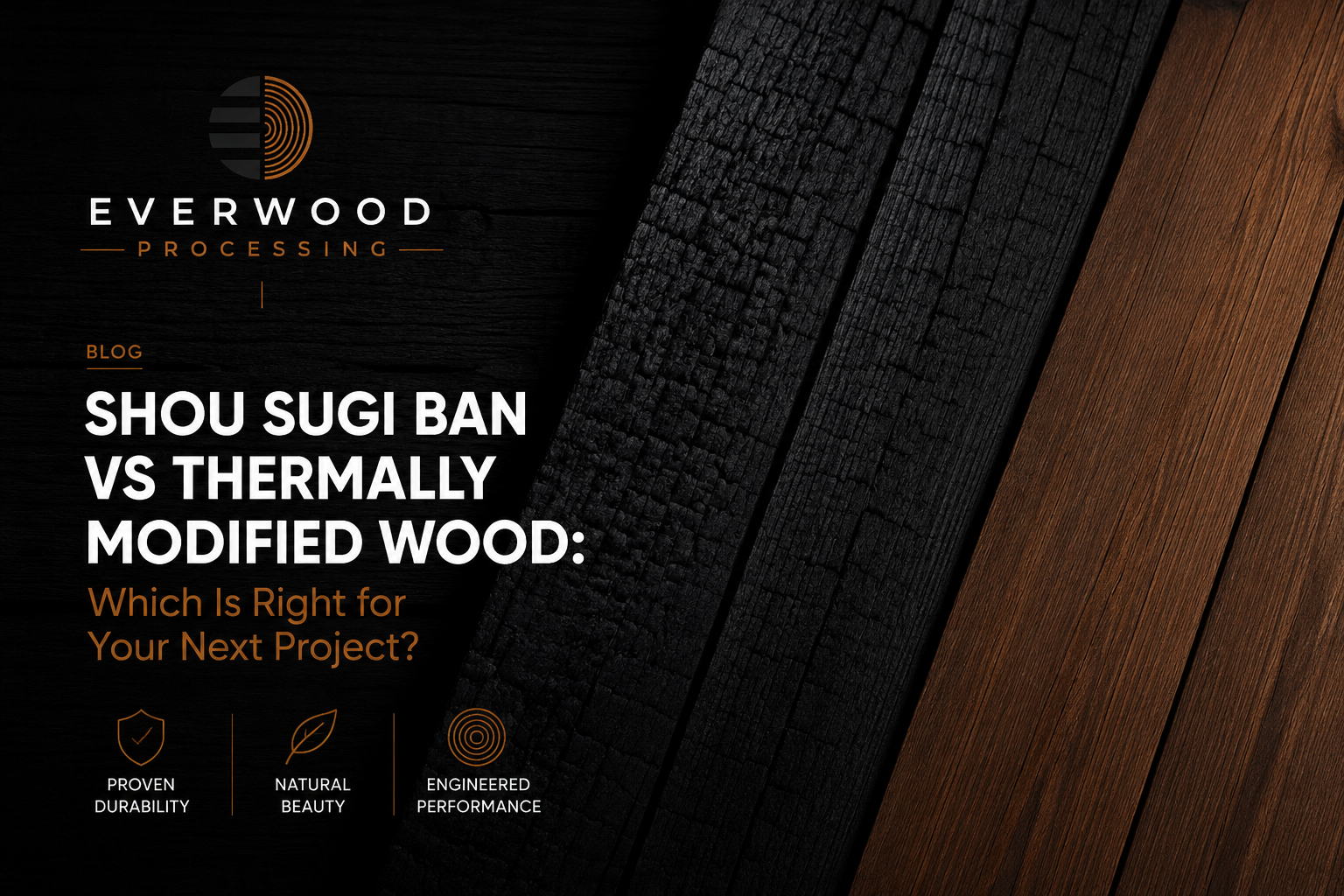
Architectural wood selection is rarely just about choosing a species. The bigger question is what the finished material needs to do. Should it create a dark, dramatic exterior? Should it stay dimensionally stable through seasonal humidity swings? Should it deliver a natural weathering profile? Should it coordinate with hidden fastening, custom profiles, or prefinished details? For many architects and builders, two options enter the conversation quickly: Shou Sugi Ban and thermally modified wood.
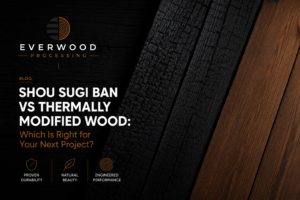
The two are sometimes discussed as if they solve the same problem. They do not. Shou Sugi Ban, often called Yakisugi in its traditional Japanese context, is a surface charring technique that creates a distinctive carbonized face and a wide range of textures. Thermally modified wood is a material modification process that uses heat and steam to change the wood throughout, improving stability and durability characteristics depending on the species and process.
Both can be excellent in the right application. Both can be used in premium architectural design. Both can support exterior cladding, siding, ceilings, accents, and specialty features. But the right choice depends on the project priorities: appearance, movement, maintenance expectations, climate exposure, fastening, budget, and how much custom processing is required before installation.
Everwood Processing works in the space where those decisions become real. EWP can support charred wood finishes, custom profiles, wire brushing, oiling, GRAD milling, beams, and other advanced wood processing services. That means the conversation does not have to stop at selecting a board. It can include how the board will be transformed, finished, fastened, and delivered for the final application.
What Is Shou Sugi Ban?
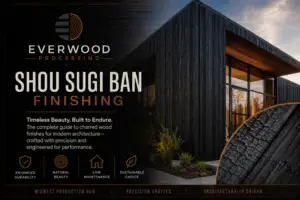
Shou Sugi Ban is the name commonly used in the United States for a Japanese wood charring technique. The more accurate traditional term is Yakisugi, especially when referring to burned cedar. In modern architectural use, the term Shou Sugi Ban has expanded to describe a range of charred wood finishes applied to several wood species, including modified woods and premium exterior cladding materials.
The process typically involves controlled burning of the wood surface, followed by cooling, brushing, cleaning, and finishing. The final look can range from deeply charred, alligator-textured black boards to brushed charcoal gray, brown-black, or subtly burned grain. Accoya describes charred wood siding as a way to emphasize grain while pairing the charred surface with the stability of Accoya wood. charred wood siding
The appeal is obvious. Shou Sugi Ban creates depth and character that paint or stain cannot fully replicate. It can look ancient and modern at the same time. On a minimalist home, it adds texture without visual clutter. On a commercial project, it can create a memorable facade. On interior feature walls or ceilings, it brings warmth, shadow, and a handcrafted surface quality.
But Shou Sugi Ban should not be treated as a magic coating. The quality of the result depends on species, moisture content, burn depth, brushing level, finish system, installation exposure, and maintenance expectations. A light torch effect is not the same as a controlled charred architectural product. The difference will show over time.
What Is Thermally Modified Wood?
Thermally modified wood is real wood that has been changed through a high-heat process, typically using heat and steam rather than chemical preservatives. Thermory explains that thermal modification improves durability, dimensional stability, and resistance to decay by changing the wood through the heat-treatment process. thermal modification improves durability and dimensional stability
The major difference is that thermal modification affects the wood beyond the surface. It changes how the material responds to moisture. Because wood movement is driven largely by moisture gain and loss, improved dimensional stability can be a major advantage in exterior applications, rainscreen cladding, decking, porch flooring, and high-design installations where movement can disrupt tight details.
Thermally modified wood is often selected when the project team wants real wood with improved outdoor performance and a natural appearance. It can be left to weather, finished with oil, brushed, profiled, grooved, or paired with hidden fastener systems. It can also be used as a base material for additional processing, depending on the species and project requirement.
The appearance of thermally modified wood is generally warmer and more natural than charred wood. It often has rich brown tones at installation, then weathers over time if left unfinished. If the design calls for a calm, natural, modern wood surface rather than a dramatic blackened finish, thermally modified wood may be a better starting point.
Appearance: Charred Drama vs Natural Warmth
The most immediate difference between Shou Sugi Ban and thermally modified wood is visual character. Shou Sugi Ban is chosen when the surface itself is meant to be a statement. It can deliver deep black texture, brushed charcoal grain, or a range of custom tones depending on the burn, brushing, and finish. It works well when contrast is part of the design: black cladding against stone, charred soffits against glass, dark vertical siding against a natural landscape.
Thermally modified wood is usually quieter. Its beauty comes from the natural board, the modified tone, and the way it is detailed. It can look refined without becoming the loudest material on the project. That makes it useful for projects where wood should warm the design but not dominate it.
Neither option is automatically more premium. A poorly controlled char can look inconsistent or fragile. A poorly detailed thermally modified wood installation can look ordinary. The premium result comes from matching material, finish, profile, fastening, and installation conditions to the design intent.
For EWP, that is the processing opportunity. A project may call for Shou Sugi Ban cladding with a specific brush level and oil finish. Another may call for thermally modified wood with a custom groove for GRAD clips. Another may combine both, using charred accent walls and natural thermally modified soffits. The question is not which material wins in general. The question is which one serves the architecture.
Performance: Surface Treatment vs Material Modification
Shou Sugi Ban and thermally modified wood improve a project in different ways. Shou Sugi Ban changes the surface. Thermally modified wood changes the material more deeply. That distinction matters.
A charred surface can help create a weathered, protective, and visually stable exterior face, but the underlying wood species still matters. The finish system still matters. Installation still matters. In fact, a USDA Forest Service research summary on charred wood siding notes that testing did not show the Shou Sugi Ban process systematically improved flammability or durability for the siding tested. That does not mean charred wood is a poor choice. It means claims should be grounded in species, process, testing, and intended use rather than marketing language alone.
For a balanced technical perspective, builders should review research such as the USDA Forest Service study on charred wood siding alongside manufacturer guidance and project-specific requirements.
Thermally modified wood, by contrast, is typically selected for improved dimensional stability and reduced moisture response. Research published through BioResources found that thermal modification significantly decreased water absorption in tested hardwoods, contributing to improved dimensional stability. That aligns with how the material is commonly positioned in architectural applications.
For additional technical context, see this study on dimensional stability and moisture behavior of thermally modified hardwoods.
The practical takeaway is straightforward. If the project priority is a dramatic surface finish, Shou Sugi Ban may be the right choice. If the project priority is wood movement, stability, and exterior performance characteristics, thermally modified wood may be the stronger base material. In some cases, the best solution may be a modified wood that also receives a charred or brushed finish.
Maintenance Expectations
Maintenance conversations should happen before the material is ordered. Owners often want a wood product that looks beautiful forever with no maintenance. Real wood does not work that way. It changes. It weathers. It responds to sun, moisture, pollutants, shade, snow, and touch. The question is not whether it will change. The question is whether the selected material and finish will change in a way the owner accepts.
Shou Sugi Ban maintenance depends heavily on burn depth, brushing, finish, exposure, and whether the surface is intended to stay dark. A heavily charred surface may age differently than a brushed and oiled charred board. High-touch areas may polish or wear. Snow, wind, driving rain, and UV exposure can affect the surface. If the design requires a consistent black tone, periodic maintenance may be part of the ownership plan.
Thermally modified wood also needs an honest maintenance plan. If left unfinished, many thermally modified woods will weather toward gray, as natural wood does. If the design requires the original brown tone, oiling or refinishing may be needed. If the project accepts natural weathering, the maintenance conversation may be simpler.
EWP can help frame these decisions around finish intent. Some projects want a controlled, finished appearance. Others want a natural weathering strategy. Others want a specialty surface that looks aged from day one. Processing, finishing, and installation should all support that decision.
Cladding, Siding, Decking, and Interior Applications
For exterior cladding and siding, both Shou Sugi Ban and thermally modified wood can be strong options, but they bring different design attitudes. Charred cladding tends to be more expressive. Thermally modified cladding tends to be warmer and more restrained. If the building has a simple form and the wood is meant to create contrast, charred material may be ideal. If the design calls for a refined natural envelope, thermally modified wood may be more appropriate.
For decking, thermally modified wood is often easier to justify because dimensional stability, comfort, and wear characteristics are central to the application. A heavily charred walking surface may not be appropriate unless specifically designed and tested for that use. Charred wood can work beautifully for vertical surfaces, soffits, ceilings, privacy walls, and accent areas where abrasion is lower.
For interiors, Shou Sugi Ban can create a powerful feature wall, fireplace surround, reception backdrop, ceiling, or hospitality element. Thermally modified wood can provide warmth for ceilings, walls, and millwork features without the intensity of a charred surface. Interior use also reduces some exterior exposure concerns, though finish, odor, touch, and dusting should still be considered.
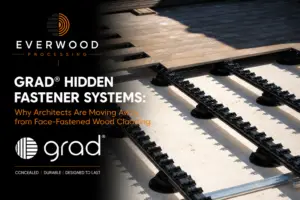
For hidden-fastener projects, the processing sequence matters. If boards need GRAD-compatible grooves, the team should decide when milling happens relative to charring, brushing, and oiling. In many cases, coordination between milling and finishing is the difference between a clean system-ready product and a field problem.
Cost and Value Considerations
Cost should be evaluated as a system, not just as a board price. Shou Sugi Ban may require additional processing steps: controlled burning, brushing, cleaning, finishing, drying time, packaging, and more careful handling. Thermally modified wood may carry a higher material cost than commodity lumber because the modification process adds value before fabrication begins. Both can be worth the investment when selected for the right reason.
A low-cost approach that ignores processing quality can become expensive later. Inconsistent burn, unstable material, poor fastening, visible screws where the design called for a clean surface, or unclear maintenance expectations can all create callbacks and owner dissatisfaction. On premium architectural projects, the cheapest path is rarely the best value.
The best value comes from matching the material to the application. Use Shou Sugi Ban when the charred surface is central to the design. Use thermally modified wood when stability and natural wood performance are central to the design. Use custom milling when the fastening system or profile requires it. Use finishing strategically so the installed assembly supports the long-term appearance the owner expects.
When to Choose Shou Sugi Ban
Choose Shou Sugi Ban when the project needs visual depth, strong contrast, and a distinctive architectural surface. It is especially effective for exterior feature walls, vertical cladding, soffits, entry elements, hospitality spaces, commercial facades, and residential projects where the wood is meant to be a signature material.
Shou Sugi Ban is a strong fit when:
- The design calls for black, charcoal, or deeply textured wood
- The surface is primarily vertical or protected from heavy abrasion
- The owner accepts a realistic maintenance plan
- The project team wants a custom finish rather than a standard stained board
- The material package can be processed under controlled conditions before installation
It may be less appropriate when the project needs a high-abrasion walking surface, a perfectly uniform factory-black appearance with no future variation, or a low-maintenance promise that exceeds what real wood can deliver.
When to Choose Thermally Modified Wood
Choose thermally modified wood when the project needs real wood with improved stability, natural warmth, and strong exterior suitability. It is a compelling choice for cladding, decking, ceilings, porch flooring, rainscreen systems, soffits, and projects where dimensional movement is a major concern.
Thermally modified wood is a strong fit when:
- The project calls for a natural wood appearance
- Dimensional stability is a priority
- The design uses long runs, tight reveals, or hidden fastening
- The owner accepts natural weathering or a planned oil maintenance cycle
- The project requires a versatile base material for profiling, grooving, brushing, or finishing
It may be less appropriate when the desired appearance is a deep charred black surface from day one, unless the thermally modified board is being used as the substrate for an additional finish process.
How EWP Helps Make the Right Choice
Everwood Processing helps bridge the gap between design selection and buildable wood packages. Many projects start with a mood board: dark cladding, natural soffits, hidden fasteners, custom beams, or textured boards. EWP helps translate those ideas into processed material that can actually be installed.
That may include selecting the right base material, determining whether Shou Sugi Ban or thermally modified wood fits the design intent, coordinating brushing or oiling, milling grooves for GRAD-compatible systems, preparing custom profiles, or supporting a broader architectural wood package. The value is not only in offering multiple services. The value is in understanding how those services affect one another.
For example, a charred cladding package may also need hidden fastening. A thermally modified ceiling package may need custom linear profiles. A beam package may need to coordinate with cladding tones. A builder may need fast lead times and repeatable milling. EWP is positioned to support those details under one roof.
Shou Sugi Ban and thermally modified wood are not interchangeable labels. They are different paths to different architectural results. Shou Sugi Ban is about controlled surface character, depth, and a distinctive charred finish. Thermally modified wood is about material modification, stability, and natural exterior performance. Both can be beautiful. Both can fail if poorly specified or processed. Both can perform well when matched to the right application.
The strongest projects start by asking the right question: what does the wood need to do? Once the answer is clear, the material, processing, fastening, and finish can all be aligned. That is where Everwood Processing brings value: helping architects and builders move from a design idea to a precise, buildable, installation-ready wood solution.
FAQs
Is Shou Sugi Ban the same as thermally modified wood?
No. Shou Sugi Ban is a surface charring technique, while thermally modified wood is changed through a heat-treatment process that affects the wood more deeply. They can sometimes be combined, but they are not the same process.
Which is better for exterior cladding?
Both can work for exterior cladding. Shou Sugi Ban is often chosen for a dramatic charred appearance, while thermally modified wood is often chosen for stability, natural appearance, and exterior performance characteristics.
Does Shou Sugi Ban make wood fireproof?
No. Charred wood should not be assumed to be fireproof. Fire performance depends on the product, species, assembly, treatment, testing, and code requirements. Always verify project-specific requirements.
Will thermally modified wood turn gray?
Many thermally modified woods will weather toward gray if left unfinished, similar to other natural wood products. If the original tone needs to be maintained, a finish and maintenance cycle should be planned.
Can EWP mill thermally modified wood or charred boards for hidden fasteners?
EWP can support custom milling and GRAD-compatible processing, but the sequence should be coordinated based on species, board profile, finish, burn level, and application.
Which option requires less maintenance?
There is no universal answer. Maintenance depends on exposure, finish, species, desired appearance, and installation conditions. A project that accepts natural weathering may require less appearance maintenance than one that needs to preserve a specific dark or brown tone.