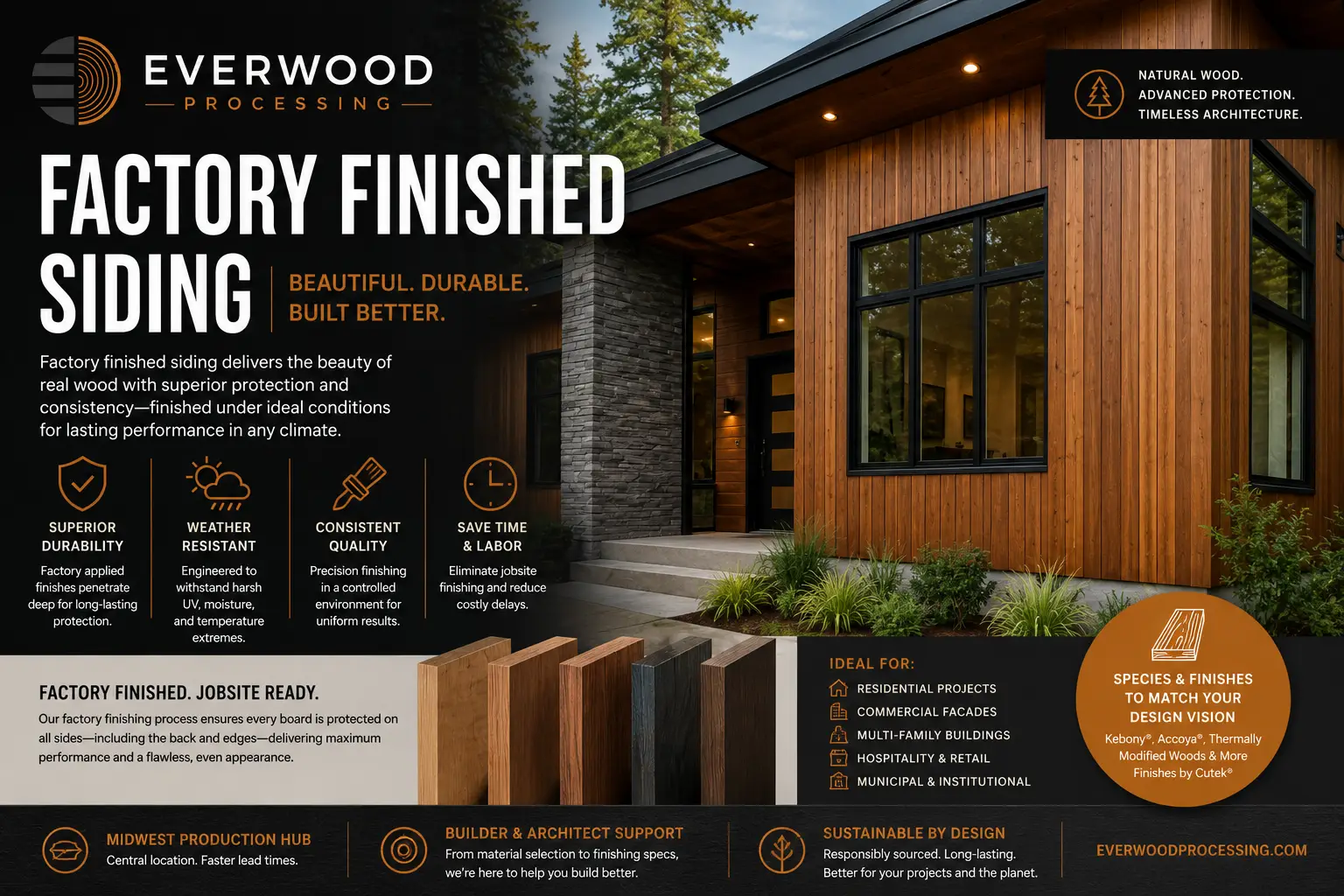
Factory finished siding gives architects and builders something jobsite finishing rarely can: consistency. When wood siding is finished before it reaches the project, every board can be prepared, coated, dried, inspected, packaged, and delivered under controlled production conditions. That matters on high-end residential, commercial, hospitality, multifamily, and institutional projects where appearance, schedule, and long-term performance are all part of the specification.
For Everwood Processing, factory finished siding is not just a coating service. It is part of a larger architectural wood processing platform that includes wire brushing, Shou Sugi Ban, GRAD precision milling, custom fabrication, modified wood processing, and laminated beam production. That combination allows architects, builders, dealers, and manufacturers to move from raw material to installation-ready wood cladding with fewer vendors, fewer field variables, and better control over the final result.
What Is Factory Finished Siding?
Factory finished siding is exterior wood cladding that receives its surface preparation and finish system before delivery to the jobsite. The process may include sanding, wire brushing, profile review, moisture evaluation, color sampling, stain or oil application, curing, quality control, and protective packaging. Everwood Processing supports this work through its wire brushing and factory finishing services, allowing premium siding materials to arrive ready for installation rather than being treated as an unfinished field operation.
The difference sounds simple, but the impact is significant. Site finishing depends on weather, crew availability, staging space, dust conditions, temperature, humidity, and application technique. Factory finishing brings those variables into a production environment where application rates, dry time, color consistency, and inspection can be better managed.
Why Factory Finishing Matters for Wood Siding
Wood siding is a premium exterior material because it delivers real texture, natural variation, warmth, and architectural depth. It is also a living material that responds to moisture, sunlight, and installation conditions. The finish system is not an afterthought – it is part of the siding assembly. A well-planned factory finish helps stabilize appearance, improve water shedding, reduce early weathering, and support a cleaner installation process.
For architects, factory finishing helps protect the design intent. For builders, it reduces field labor and schedule risk. For owners, it creates a more predictable exterior appearance from day one. For dealers and manufacturers, it adds value to premium siding packages by turning raw boards into a more complete architectural product.
Industry guidance supports the value of pre-finishing exterior wood. The Western Red Cedar Lumber Association notes in its finishing education that cedar siding performs best when it is pre-primed or pre-finished before jobsite delivery, with attention to coating all sides and resealing field cuts. For broader wood design and construction guidance, the American Wood Councilprovides technical resources used across the building industry, while the Western Red Cedar Lumber Association finishing guidance is especially useful for understanding best practices around exterior cedar preparation and finishing.
Key Benefits of Factory Finished Siding
- More consistent color: Factory application helps reduce the blotchy or uneven appearance that can happen when multiple people finish boards onsite using different tools, timing, or techniques.
- Reduced jobsite labor: Boards arrive closer to installation-ready, which can reduce time spent staging, coating, drying, moving, and protecting material onsite.
- Better schedule control: Factory finishing is less dependent on weather windows than field finishing, especially in cold, humid, dusty, or high-traffic construction environments.
- Improved edge and back-side attention: Project specifications can call for coating strategies that address faces, backs, edges, ends, and field cuts according to the selected product and finish system.
- Cleaner installation: Finished siding packages reduce overspray, drips, cleanup, and protection issues around windows, masonry, roofing, hardscape, and adjacent trades.
- More predictable weathering: A consistent initial finish can help the siding weather more evenly over time, especially when the owner wants a controlled natural-wood appearance rather than a patchy transition.
- Premium architectural appearance: Factory finishing enhances grain, texture, profile definition, and material character before the product reaches the wall.
Factory Finished Siding vs Site Finished Siding
| Factor | Factory Finished Siding | Site Finished Siding |
| Color consistency | Controlled application and batch review help improve consistency across boards. | More dependent on installer technique, weather, and daily jobsite conditions. |
| Schedule risk | Material can arrive ready to install, reducing onsite finishing delays. | Work may be delayed by rain, humidity, temperature, dust, or trade sequencing. |
| Labor demand | Less field labor required for coating and drying. | Requires staging, finishing, drying time, handling, and protection onsite. |
| Quality control | Boards can be reviewed before packaging and shipment. | Defects may be discovered after installation or after multiple trades are already scheduled. |
| Best use case | Premium projects where consistency, efficiency, and appearance matter. | Small projects, repairs, or cases where onsite color decisions are unavoidable. |
Best Wood Materials for Factory Finished Siding
Factory finishing can be applied to many architectural siding materials, but the best choice depends on the building type, exposure, design intent, and budget. Everwood Processing regularly supports premium wood programs where the siding material is selected for both beauty and performance.
Kebony
Kebony modified wood is often specified where designers want real wood character with enhanced stability and durability. Factory finishing can help establish the desired tone and support a more controlled appearance at installation.
Accoya
Accoya is known for dimensional stability and exterior durability. It is frequently used in high-performance cladding applications where coating performance and substrate stability are both important.
Thermally modified wood
Thermally modified species offer a rich appearance and improved stability compared with many conventional woods. Factory finishing can enhance tone, reduce early variation, and support modern cladding aesthetics.
Western red cedar
Cedar remains a classic siding material because of its light weight, natural beauty, and favorable finishing characteristics. It benefits from thoughtful pre-finishing and end-grain attention.
Select hardwoods and specialty species
Some projects call for hardwoods or specialty species for distinctive color, density, or grain. These materials require careful finish testing and specification review before production.
The Role of Wire Brushing Before Factory Finishing
Wire brushing can dramatically change the final appearance of wood siding. By removing softer surface fibers and highlighting the grain, wire brushing creates a more tactile, dimensional surface. It can soften the look of uniform boards, add depth to dark finishes, and create more visual interest in vertical or horizontal cladding systems.
For architects, wire brushing is a design tool. For builders, it is a way to receive boards with a consistent surface texture instead of relying on field preparation. For manufacturers and dealers, it creates a higher-value product that looks more intentionally architectural. When combined with factory finishing, wire brushing can produce siding that feels finished, specified, and purpose-built rather than commodity lumber with stain added later.
Where Factory Finished Siding Performs Best
Commercial facades
Retail, office, education, civic, and hospitality buildings often require consistent exterior cladding across large elevations. Factory finishing helps maintain visual control across large production runs.
Luxury residential exteriors
Custom homes benefit from refined natural wood appearance, clean installation, and better coordination between siding, soffits, beams, trim, and interior-exterior transitions.
Multifamily and mixed-use projects
Factory finished siding can simplify schedule coordination and reduce onsite finishing complications on larger projects with multiple elevations and phases.
Soffits and covered ceilings
Wood soffits are highly visible architectural surfaces. A factory finish helps achieve a consistent tone before boards are installed overhead.
Rainscreen cladding systems
Open-joint and ventilated rainscreen assemblies require careful planning. Factory finished boards can support cleaner installation and better design alignment.
Specification Considerations for Architects
Factory finished siding should be specified as a complete system, not as a generic color request. The specification should address substrate, profile, finish chemistry, sheen, color range, texture, face orientation, back-side requirements, end sealing, packaging, handling, and maintenance expectations. The more clearly these decisions are made before production, the fewer surprises occur during installation.
- Confirm species, grade, profile, and exposed face before finish approval.
- Request physical samples rather than relying only on digital renderings.
- Review color under natural light and in the project climate when possible.
- Define whether the finish is intended to maintain color, allow controlled weathering, or support eventual patina.
- Specify treatment of ends, edges, backs, and field cuts based on manufacturer guidance and project exposure.
- Coordinate fasteners, rainscreen clips, furring, and trim details before production.
- Plan for maintenance access on high-exposure elevations.
Builder Considerations: Handling, Cutting, and Installation
Factory finished siding still needs proper jobsite handling. Finished boards should be stored clean, dry, elevated, and protected from standing moisture. Packaging should remain intact until installation, but boards should not be trapped in wet conditions. Installers should follow the siding manufacturer recommendations for ventilation, fastener spacing, expansion gaps, and field-cut treatment.
Field cuts are especially important. Even when boards are factory finished, cut ends may expose uncoated wood. Many systems require cut-end sealing or touch-up to maintain appearance and performance. This should be addressed in the bid documents and installation plan so it does not become a field improvisation.
Factory finished siding also pairs well with specialty architectural services. For projects that require concealed fastening or removable board systems, Everwood can coordinate finishing with GRAD precision milling. For projects that require darker, more dramatic exterior wood, factory finishing may also be coordinated with Shou Sugi Ban wood charring where appropriate for the material and application.
Common Mistakes to Avoid
- Treating finish as a color only: A siding finish is a performance and appearance system, not simply a stain color.
- Ignoring field cuts: Cut-end treatment should be planned before installation, not decided after boards are on the wall.
- Skipping samples: Natural wood variation makes physical samples essential for approval.
- Choosing the wrong material for exposure: Not every species or finish is appropriate for every climate, elevation, or maintenance expectation.
- Underestimating UV exposure: South and west elevations typically weather differently than shaded elevations. Owners should understand this before approval.
- Finishing too late in the schedule: Waiting until the jobsite is busy increases the risk of dust, overspray, sequencing delays, and inconsistent application.
Why Everwood Processing for Factory Finished Siding?
Everwood Processing is built for specialty architectural wood processing. The company supports commercial buyers, architects, builders, dealers, distributors, and manufacturers who need more than a commodity siding supplier. Projects can be supported with customer-supplied material or sourced material, and production can be coordinated from a Midwest processing hub serving projects nationally.
The advantage is not only the finish. It is the ability to align finishing with other services, including wire brushing, GRAD milling, Shou Sugi Ban, custom fabrication, and other architectural wood processing. That allows a siding package to be built around the project rather than forcing the project to adapt to whatever a commodity material supplier can provide.
- Midwest production hub with national project support
- Factory finishing and wire brushing under one roof
- Ability to process customer-supplied or sourced materials
- Support for architects, builders, dealers, and commercial buyers
- Coordination with GRAD milling, Shou Sugi Ban, and custom fabrication
- Production-focused quality control and builder-ready packaging
FAQ: Factory Finished Siding
Is factory finished siding better than site finished siding?
For most premium wood siding projects, factory finishing offers better consistency, lower jobsite labor, and less weather-related schedule risk. Site finishing can still be useful for small projects or repairs, but it is harder to control on larger architectural cladding packages.
Can factory finished siding be used on commercial buildings?
Yes. Factory finished wood siding is well suited for commercial facades, hospitality, mixed-use, education, civic, and multifamily projects where appearance and schedule reliability matter.
Does factory finished siding still need maintenance?
Yes. Factory finishing reduces many variables, but exterior wood still needs a maintenance plan. The schedule depends on the species, finish system, UV exposure, climate, building orientation, and desired appearance.
Can Everwood Processing finish customer-supplied siding?
Yes. Everwood Processing can work with customer-supplied materials or help source appropriate materials for the project.
Can siding be wire brushed before finishing?
Yes. Wire brushing is one of the best ways to add texture, highlight grain, and create a more architectural surface before finish application.
What wood species can be factory finished?
Common options include Kebony, Accoya, thermally modified wood, cedar, and select hardwoods. The best material depends on exposure, desired appearance, budget, and project requirements.
Can factory finishing be combined with hidden fastener milling?
Yes. For compatible materials and profiles, factory finishing can be coordinated with GRAD precision milling or other fastening preparation to create installation-ready siding systems.
Should all sides of wood siding be finished?
Many exterior siding systems benefit from multi-side finishing or priming, but the exact requirement depends on the species, finish manufacturer, profile, and project specification. Field cuts should be sealed according to product guidance.
Conclusion: Better Siding Starts Before the Jobsite
Factory finished siding gives architects, builders, and owners a stronger starting point. Instead of sending raw wood to a busy jobsite and hoping the finish turns out evenly, the material can be prepared, coated, inspected, and packaged in a controlled environment. The result is cleaner installation, more consistent appearance, reduced labor pressure, and a better path toward long-term performance.
For projects that demand premium wood cladding, Everwood Processing provides the specialty processing support needed to move from design intent to installation-ready siding. From wire brushing and factory finishing to GRAD milling, Shou Sugi Ban, and custom fabrication, Everwood helps commercial buyers simplify complex wood packages and deliver architectural results with confidence.
Suggested Blog Image: A modern commercial or luxury residential facade with warm factory finished wood siding, clean shadow lines, and a subtle Everwood Processing branded overlay highlighting “Factory Finished Siding,” “Consistent Color,” “Reduced Field Labor,” and “Midwest Production Hub.”