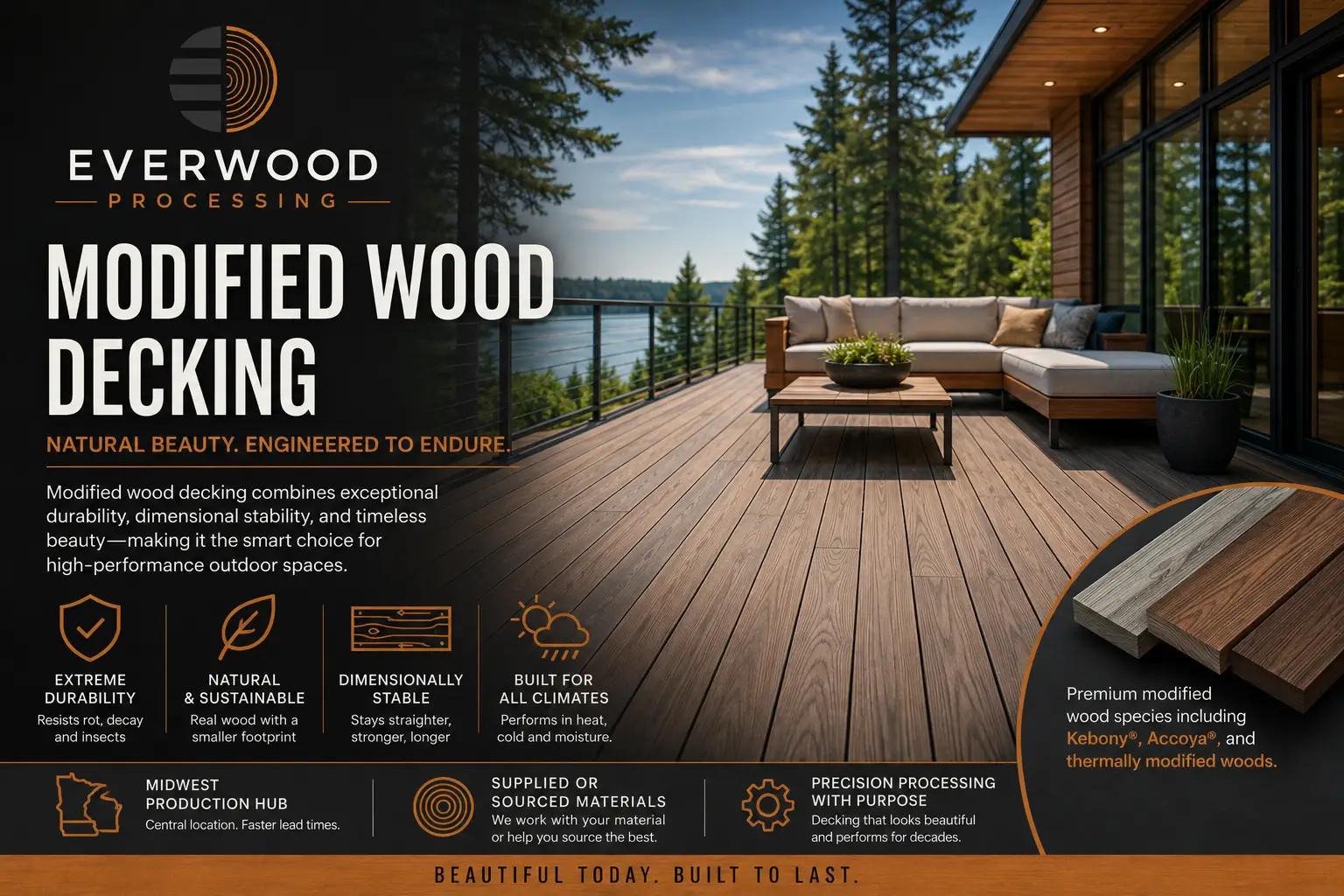
Modified wood decking is becoming one of the strongest material choices for architects, builders, developers, and homeowners who want the appearance of real wood without accepting the movement, checking, and maintenance expectations of ordinary exterior lumber. For premium decks, rooftop terraces, boardwalks, pool surrounds, and commercial outdoor spaces, modified wood offers a compelling balance of natural beauty, dimensional stability, durability, and design flexibility. The difference is not just the board itself. Long-term performance depends on species selection, compatible fastening, accurate milling, ventilation, factory preparation, and installation-ready detailing.
Everwood Processing supports these projects as a Midwest production partner for advanced architectural wood processing. Our team helps prepare modified wood decking through precision milling, GRAD-compatible grooves, wire brushing, factory finishing, custom profiles, and project-ready fabrication. For decking and patio projects, Everwood Processing focuses on clean aesthetics, consistent board spacing, efficient installation, and long-term outdoor performance. Learn more about our decking and patio processing services.
What Is Modified Wood Decking?
Modified wood decking is real wood that has been enhanced through a physical or chemical modification process to improve outdoor performance. Instead of relying only on traditional preservatives, the wood itself is changed so that it becomes more dimensionally stable and less vulnerable to moisture-related movement and biological degradation. The goal is to preserve the warmth, grain, and authenticity of wood while reducing some of the weaknesses that make conventional decking harder to maintain.
The most common categories in premium architectural decking include acetylated wood, furfurylated wood, and thermally modified wood. Accoya is an example of acetylated wood. Kebony is a leading example of furfurylated modified wood. Thermory and other thermally modified products use heat and steam to change the wood structure. These materials are not identical, but they are often evaluated together because all three serve architects and builders looking for higher-performance natural wood options.
For product-specific research, designers should review manufacturer documentation. Kebony modified wood decking is positioned for decking, cladding, and outdoor applications, while Accoya acetylated wood is widely used for exterior applications that require high dimensional stability and long-term durability. Manufacturer documentation, project exposure, code requirements, and fastening compatibility should always be reviewed before final specification.
Why Modified Wood Is Gaining Market Share in Premium Decking
The top-ranking decking content online often compares wood to composite, PVC, pressure-treated lumber, cedar, redwood, and tropical hardwoods. That comparison matters, but it often misses the most important point for architects: the best decking material is not only a product decision. It is a system decision. The board, fastening method, ventilation strategy, finish, edge profile, drainage condition, and installation sequence all work together. Modified wood is gaining traction because it can be designed as a complete architectural system rather than a commodity deck board.
Design teams specify modified wood decking because it offers real wood character with improved performance characteristics. Builders like it because high-quality modified wood is generally more predictable than many conventional lumber options. Owners like it because it can weather naturally, be cleaned, be maintained, and still feel like wood underfoot. Unlike many synthetic boards, modified wood can also be refinished or refreshed depending on the finish system and exposure conditions.
Key Benefits of Modified Wood Decking
- Real wood appearance: Modified wood is still wood. Grain, tone, texture, and variation remain part of the finished surface, which is why it works well in high-design residential and commercial environments.
- Improved dimensional stability: Modification reduces the swelling and shrinking behavior that often causes cupping, warping, and gapping issues in conventional exterior wood.
- Premium architectural flexibility: Modified wood can be milled, brushed, finished, grooved, and detailed for modern decks, terraces, exterior walkways, and integrated cladding-to-deck transitions.
- Comfortable outdoor surface: Many designers prefer real wood for barefoot comfort, visual warmth, and the natural way it responds to outdoor environments.
- Responsible material story: When sourced from responsibly managed forests and manufactured through reputable processes, modified wood can support sustainability-focused design goals.
- Compatibility with hidden fastening: When boards are correctly milled and matched to a fastening system, modified wood can produce clean, screw-free deck surfaces with consistent spacing.
The Main Types of Modified Wood Used for Decking
Kebony Modified Wood
Kebony is frequently specified for premium decking, cladding, terraces, and exterior architectural applications. It begins as real wood and is modified to improve durability, hardness, and stability. For architects, Kebony is attractive because it delivers a refined natural appearance while reducing reliance on tropical hardwoods. It can be used in modern residential decks, commercial terraces, hospitality spaces, boardwalks, and landscape architecture.
Accoya Modified Wood
Accoya is acetylated wood known for stability, durability, and versatility in exterior applications. Designers often evaluate Accoya where movement control is critical, such as wide boards, exterior details, and applications that need consistent performance. While Accoya is frequently associated with cladding, windows, doors, and specialty exterior components, it is also used in decking and public-space applications when properly specified.
Thermally Modified Wood
Thermally modified wood is treated with heat and steam to improve stability and decay resistance. It is popular in decking, siding, soffits, and interior/exterior architectural surfaces. Depending on the species and manufacturer, thermally modified decking can offer a rich brown tone at installation and a refined weathered appearance over time. It should be specified carefully because product quality, treatment depth, species, and installation guidance vary by manufacturer.
Modified Wood Decking Compared to Other Decking Materials
| Material | Appearance | Stability | Maintenance | Best Fit |
| Modified wood | Natural wood grain and premium appearance | High, depending on product | Low to moderate; refresh finishes as desired | Architectural decks, terraces, commercial outdoor spaces |
| Composite decking | Consistent manufactured look | Good | Low, but limited refinishing options | Residential decks where low maintenance is the top priority |
| PVC decking | Synthetic appearance varies by brand | Good | Low | Wet areas and projects prioritizing synthetic durability |
| Pressure-treated lumber | Traditional deck appearance | Variable | Moderate to high | Budget-conscious residential framing and decking |
| Tropical hardwood | Dense, rich natural appearance | Good when properly dried and installed | Moderate; can be difficult to machine | High-end decks where cost and sourcing are acceptable |
Why Precision Milling Matters
Premium decking fails visually when small details are left uncontrolled. Board spacing that changes across a deck, exposed screw heads, inconsistent groove depth, field improvisation, and poor edge alignment can make an expensive material look ordinary. Precision milling helps solve those problems before the boards ever reach the jobsite.
Everwood Processing provides custom groove milling that prepares compatible wood boards for the GRAD hidden-fastener system. This is especially valuable for modified wood decking because the finished surface can remain clean and uninterrupted while the board spacing and alignment are controlled by the system. For architects and builders exploring hidden fasteners, our GRAD milling service can help turn a premium material into a more installation-ready package.
GRAD-style clip-on assemblies can also support serviceability. On many systems, boards can be removed and replaced with less disruption than fully face-fastened assemblies. That matters for commercial rooftop decks, multifamily amenity spaces, restaurants, and high-traffic outdoor areas where access to waterproofing, drains, lighting, or utilities may be needed over the life of the project.
For technical background on wood design and construction, architects and builders can also reference the American Wood Council and manufacturer installation guidance. For engineered wood product standards and structural wood resources, the APA – The Engineered Wood Association is another valuable authority source. These resources do not replace project-specific engineering, but they support better specification decisions.
Factory Finishing and Surface Texture Options
Modified wood decking may be left to weather naturally, finished with penetrating oil, textured through wire brushing, or prepared with a project-specific surface treatment. The right decision depends on the owner’s design intent. Some owners want the wood to move gradually toward a silver-gray patina. Others want to preserve a warmer brown tone for as long as possible. Still others want a textured, brushed surface that emphasizes grain and creates a more tactile architectural finish.
Factory finishing helps reduce jobsite variability. Instead of asking installers to coat boards outdoors under changing temperature, dust, humidity, and schedule pressure, factory-applied finishes can create more consistent coverage before delivery. This is especially important on commercial projects where color consistency, schedule control, and installation efficiency matter. Everwood Processing can coordinate surface preparation and finishing with other processing services so that boards arrive closer to installation-ready condition.
Best Applications for Modified Wood Decking
- Luxury residential decks: Modified wood provides the natural warmth expected in custom homes while supporting cleaner detailing than ordinary lumber.
- Rooftop terraces: Dimensional stability, precise spacing, and serviceable decking systems are especially important over membranes and drainage assemblies.
- Commercial patios and hospitality spaces: Restaurants, resorts, clubs, and hotels benefit from a surface that feels premium and can be designed around heavy use.
- Boardwalks and public outdoor spaces: Modified wood can deliver a refined natural look for civic projects, parks, waterfronts, and institutional landscapes.
- Pool surrounds: Designers often want a warm, barefoot-friendly material around water features, but drainage, slip resistance, and maintenance expectations must be carefully reviewed.
- Mixed cladding and decking projects: Using related species, finishes, and profiles across vertical and horizontal surfaces can create cohesive architecture.
Specification Checklist for Architects and Builders
- Confirm the exact modified wood product, grade, profile, and manufacturer warranty.
- Review code compliance, fire requirements, slip resistance needs, and local permitting conditions.
- Confirm joist spacing, ventilation, drainage, and minimum ground clearance.
- Select compatible fasteners or hidden-fastener systems before finalizing board profiles.
- Specify whether the deck will weather naturally or receive a factory-applied finish.
- Plan access to drains, waterproofing, lighting, and utilities beneath rooftop or commercial deck assemblies.
- Coordinate mockups or samples for color, texture, board width, and finish expectations.
- Confirm lead times for milling, finishing, packaging, and delivery before committing to the construction schedule.
Common Mistakes to Avoid
- Choosing the material before choosing the fastening system: Hidden fastening, face fastening, plugs, clips, and GRAD-compatible systems all affect board profile, milling, labor, appearance, and serviceability.
- Ignoring ventilation and drainage: Even high-performance wood needs proper deck design. Water must move away from the assembly and boards must be allowed to dry.
- Assuming all modified woods behave the same: Kebony, Accoya, Thermory, and other modified woods use different technologies and should be specified according to product data.
- Treating finish as an afterthought: Finish expectations should be discussed early. A naturally weathered deck and a warm-tone maintained deck are different ownership decisions.
- Skipping samples and mockups: Modified wood changes with exposure. Samples help set expectations for color, texture, fastener appearance, and weathering.
How Everwood Processing Supports Modified Wood Decking Projects
Everwood Processing is not simply a material reseller. The value is in preparing premium wood for real projects. Architects and builders often need more than boards. They need coordination between drawings, species, profiles, fasteners, finishes, samples, and schedule requirements. Our role is to help bridge the gap between design intent and jobsite execution.
From our Midwest production hub, Everwood Processing can support customer-supplied or sourced material, precision groove milling, custom profiles, wire brushing, factory finishing, Shou Sugi Ban for appropriate applications, and laminated beam coordination for broader outdoor environments. That makes it easier to manage complex architectural wood packages under one roof instead of coordinating multiple vendors for each step.
Modified Wood Decking FAQs
Is modified wood decking real wood?
Yes. Modified wood decking is real wood that has been enhanced through acetylation, furfurylation, thermal modification, or another approved process. It retains natural grain and texture while improving outdoor performance.
Is modified wood better than composite decking?
It depends on the project. Modified wood is often better for projects that prioritize natural appearance, architectural detailing, refinishing potential, and real wood character. Composite may be better when the owner wants a synthetic, low-maintenance product above all else.
Does modified wood decking turn gray?
Many modified woods will weather toward a silver-gray patina when left unfinished or when finishes naturally wear. Owners who want to maintain a warmer tone should plan a cleaning and oil-refresh schedule.
Can modified wood be used with hidden fasteners?
Yes, many modified wood products can be used with hidden fastening systems when profiles are milled correctly and the fastening system is approved for the board. Everwood Processing can help prepare GRAD-compatible profiles for selected materials.
Can Everwood Processing work with customer-supplied decking boards?
Yes. Everwood Processing can process customer-supplied materials or help source appropriate species for the project. Material compatibility should be reviewed before milling or finishing begins.
Is modified wood decking low maintenance?
Modified wood is generally lower maintenance than many conventional wood options, but it is not maintenance-free. Cleaning, finish refreshes, and inspection schedules depend on exposure, species, finish system, and owner expectations.
What is the best modified wood for decking?
There is no single best product for every project. Kebony, Accoya, Thermory, and other modified woods each have strengths. The right choice depends on exposure, fastening system, finish goal, budget, code requirements, and design intent.
Can modified wood decking be factory finished?
Yes. Factory finishing can improve consistency and reduce jobsite variability. Everwood Processing offers factory preparation and finishing support for compatible wood products.
Is modified wood suitable for commercial decks?
Yes. Modified wood is frequently used for hospitality terraces, rooftop amenities, public spaces, boardwalks, and commercial outdoor areas. Commercial projects should review structural, code, slip resistance, and maintenance requirements before specification.
Why use Everwood Processing instead of ordering boards directly?
Everwood Processing adds production value: precision milling, GRAD preparation, custom profiles, factory finishing, texture options, samples, and project coordination. That helps premium materials arrive ready for cleaner, faster, more consistent installation.
Conclusion: Better Decking Starts Before Installation
Modified wood decking is one of the best options for projects that need real wood beauty, improved stability, long-term outdoor performance, and premium architectural detailing. But the board alone does not create the finished result. The best projects combine the right species, proper profile, compatible hidden fastening, ventilation, drainage, finish planning, and precise fabrication.
Everwood Processing helps architects, builders, dealers, and commercial project teams turn modified wood decking into a more complete system. With GRAD milling, wire brushing, factory finishing, custom profiling, and Midwest production support, EWP helps reduce coordination problems and deliver project-ready materials for modern outdoor spaces.
Call to action: Send your drawings, board specifications, or decking concept to Everwood Processing to discuss material compatibility, GRAD milling, finishing options, samples, and project-ready production support.