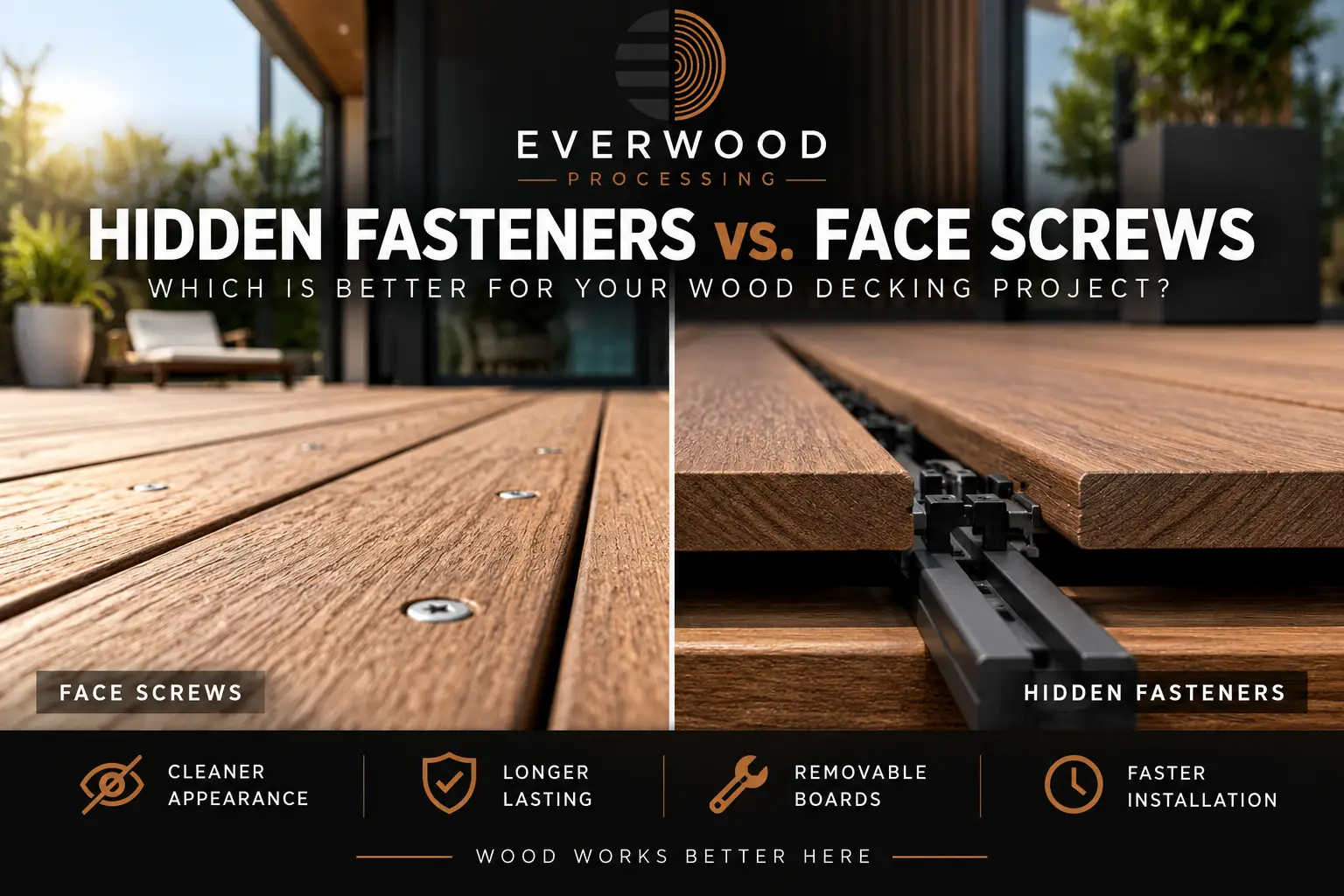
The fastener may be one of the smallest components in a deck, but it has an outsized effect on how the finished surface looks, how efficiently crews install it, and how easily the deck can be serviced years later. For homeowners, architects, builders and lumber dealers selling premium wood, the decision usually comes down to two approaches: fastening through the face of the board or using a concealed system below the walking surface.
For premium projects, hidden fastening is increasingly attractive because it keeps the surface uninterrupted. Everwood Processing supports this approach through precision milling for the GRAD® system and other advanced processing used in decking and patio applications. The important point is not that one fastening method is universally “better.” The right choice depends on the material, budget, design intent, installation conditions and long-term service requirements.
Hidden Fasteners vs. Face Screws: The Short Answer
Hidden fasteners are generally the stronger choice when the goal is a clean architectural surface, controlled board spacing and a premium appearance. Face screws remain practical for straightforward installations, perimeter boards, stairs, repairs and projects where initial material cost is the overriding concern. Many well-designed decks use both methods: concealed fastening across the primary field and carefully detailed face fastening where geometry requires it.
Why Hidden Deck Fasteners Change the Finished Appearance
With face fastening, every board is mechanically secured from above. Even when stainless or color-matched screws are installed neatly, the fastener pattern remains part of the visual field. That can be acceptable on utility decks, but it is harder to ignore on Kebony®, Accoya®, Thermory®, cedar or a premium hardwood selected specifically for its grain and character.
A concealed system moves the connection below the visible surface. With GRAD hidden-fastener systems, compatible boards are precision milled so they engage clips mounted to engineered rails. The result is a continuous wood surface without rows of screw heads or plugs competing with the material.
Board Spacing and Alignment Matter More Than Most Buyers Expect
A high-end deck can use expensive lumber and still look ordinary if the gaps wander from one end to the other. Traditional face fastening relies heavily on installer layout, spacers and consistency at every joist. A rail-and-clip system establishes repeatable fastening points and can help maintain consistent reveals across the installation. That is especially valuable on large commercial terraces, multifamily amenity decks and highly visible residential projects.
Installation: Compare the Entire System, Not Just the Screw
Face screws are familiar and require relatively simple hardware, which is why they remain common. Hidden systems require compatible profiles and correct preparation. However, systems with clips pre-positioned on rails change the labor equation: crews secure the rail assembly and then engage prepared boards rather than individually laying out every visible fastening point. The value becomes more apparent as project size and finish expectations increase.
Planning must happen before material reaches the jobsite. Board thickness, groove geometry, rail spacing, framing layout and edge details all need to work together. Everwood Processing helps move that coordination upstream by machining approved boards in a controlled production environment so material can arrive prepared for the specified installation system.
Removable Deck Boards Are a Major Commercial Advantage
A damaged board on a conventional deck can turn into a surprisingly disruptive repair. Rooftop and commercial decks add another issue: owners may eventually need access to drains, waterproofing, lighting, utilities or the supporting assembly below the finished surface. A serviceable clip-on system can allow selected boards to be removed and returned to position without dismantling broad areas of decking, depending on the system design.
What About Moisture and Wood Movement?
Wood responds to moisture and environmental conditions. The USDA Forest Products Laboratory Wood Handbook explains the relationship between wood moisture content, dimensional change and performance. That is why species selection, ventilation, board spacing, fastening details and acclimation should be treated as a system rather than separate decisions.
Modified woods such as Accoya, Kebony and thermally modified products are often selected when improved dimensional stability is important. Hidden fastening does not eliminate the need to follow the decking manufacturer’s technical requirements, but precision milling and controlled spacing can support a more predictable assembly.
When Face Screws Are Still the Right Choice
Face fastening has legitimate advantages. It is simple, familiar and compatible with a broad range of board profiles. Stairs, picture-frame borders, starter or closure boards and unusual details may require top fastening even when the main deck field uses concealed clips. For a budget-driven deck where visible hardware is acceptable, quality stainless fasteners installed correctly can also be a sensible solution.
Structural requirements always come first. The American Wood Council deck resources provide technical guidance for residential wood deck construction, while project-specific engineering, local codes and manufacturer requirements govern the actual assembly. A hidden-fastener specification should never be used as a substitute for proper structural design.
Why Precision Milling Is the Difference
Hidden fastening performs only as well as the interface between the board and the hardware. Groove depth, position and profile must be consistent. Small machining errors repeated across hundreds of boards can become installation problems, inconsistent engagement or wasted jobsite time. Factory milling transfers that precision from the field to controlled production.
Everwood Processing works with architects, builders, dealers and homeowners to evaluate approved materials and prepare installation-ready boards. Projects can also combine GRAD milling with wire brushing and factory finishing so texture, finish and fastening preparation are coordinated before delivery.
Which Deck Fastening System Should You Choose?
Choose hidden fasteners when clean aesthetics, repeatable spacing and serviceability are priorities. Choose face screws where simplicity, special details or initial hardware cost matter more. For many premium projects, the best answer is a hybrid: hidden fastening across the field with purpose-designed face fastening only where necessary. Decide early, because the fastening method affects board profiles, quantities, milling and installation planning.
Frequently Asked Questions
Are hidden deck fasteners better than screws?
For premium wood decks, hidden fasteners often provide a cleaner appearance and more controlled spacing. Face screws remain appropriate for certain details and budget-focused installations.
Can real wood decking use hidden fasteners?
Yes. Many approved wood and modified-wood products can be precision milled for concealed fastening systems when the board and system are compatible.
Can a hidden-fastener deck board be replaced?
Some systems, including serviceable rail-and-clip assemblies, are designed to make individual board access easier. Confirm the exact removal procedure for the specified system.
Do hidden fasteners eliminate all face screws?
Not always. Stairs, borders, perimeter conditions and closure boards may still require face fastening or another approved detail.
What wood can Everwood Processing prepare for hidden fastening?
EWP works with approved materials including Kebony, Accoya, Thermory, Arbor Wood, Dasso Bamboo, cedar, hardwoods and other project-specific materials evaluated for compatibility.
Planning a premium deck? Contact Everwood Processing to discuss material selection, GRAD-compatible milling, finishing and project-ready preparation.